(604)732-7678
2526 W 5th Ave, Vancouver, BC V6K 1T1

Wills & Estate Planning

Why Probate Gets Delayed in BC

Probate

Why Probate Gets Delayed in BC: 7 Executor Mistakes to Avoid

Professional handshake in an office, representing guidance and support during probate and estate administration in British Columbia
Probate in BC Executor guidance
Probate and Estate Administration Probate delays often become easier to manage once the real issue is identified. Executors in British Columbia are often dealing with paperwork, uncertainty, family tension, and missing estate details all at once. A clearer review can help show what is actually slowing the process down.

If probate is taking longer than you expected, it does not always mean you have done something wrong.

In British Columbia, probate is often delayed because the estate information is incomplete, the paperwork is not fully lined up, questions arise about the Will or the executor’s role, or a new asset or debt appears after the process has already started.

Many executors assume they are supposed to know exactly what to do from the beginning. In real life, that is rarely how it feels. You may be trying to gather documents, answer questions from family, sort out bank accounts or property, and make sense of a legal process while also dealing with grief.

The good news is that probate delays are often easier to understand once you know what usually causes them. In many cases, the estate is not impossible to manage. It is simply stuck on one or two issues that need clearer attention.

If you are an executor and something feels off, Tim Louis can help you review the estate documents, identify what may be slowing things down, and explain the safest next step.

Call 604-732-7678 or email timlouis@timlouislaw.com for a free consultation.

Why probate gets delayed in BC

Probate delays in BC are often practical, not mysterious.

In many estates, the process slows down because the executor is still trying to piece together the full estate picture, the paperwork is incomplete, there is uncertainty about what the Will requires, or family tension begins to affect decisions.

In plain language, probate is more likely to stall when one of these problems appears:

  • the executor does not yet have a full list of assets and debts
  • notices, forms, or supporting documents are incomplete
  • the Will or the executor’s role is not fully understood
  • conflict between family members starts affecting the estate
  • a new asset or liability is discovered later than expected

That is why many probate delays feel confusing at first. The estate may seem simple on the surface, but one unresolved issue can slow everything down. The good news is that once the source of the delay is identified, the next step is often much clearer.

If you are not sure what is causing the delay, Tim Louis can help you review the estate documents and explain what may need attention next. Call 604-732-7678 or email timlouis@timlouislaw.com for a free consultation.

The 7 executor mistakes that often delay probate in BC

Most probate delays do not happen because an executor is careless. They happen because the role is bigger than people expect, and the process becomes harder when one key issue is missed.

These are some of the most common executor mistakes that can slow probate in BC.

1. Moving ahead without a complete list of assets and liabilities

This is one of the most common causes of delay.

Executors often start with only part of the estate picture. There may be bank accounts, investments, debts, property interests, or other assets that are not fully identified at the beginning.

What this means for you: if you are not sure the estate list is complete, that uncertainty alone can delay probate.

2. Treating the executor role like a family favour instead of a legal responsibility

Many executors begin with good intentions. They want to help, keep the peace, and do right by the family.

But an executor is not only a helper. The role carries legal responsibilities, not just family expectations.

What this means for you: your job is not to guess or to satisfy everyone at once. Your job is to administer the estate properly.

3. Underestimating how much paperwork matters

Some estates are delayed not because of conflict, but because the paperwork is incomplete, inconsistent, or missing something important.

Even when the estate seems straightforward, probate can slow down if the supporting materials are not fully lined up or if information later has to be corrected.

What this means for you: a delay is not always a sign of a major legal dispute. Sometimes it is a sign that the process needs closer attention.

4. Waiting too long to deal with confusion about the Will or the executor role

Executors often hesitate because they are afraid of making the wrong move.

That hesitation is understandable. But if the Will is unclear, if the executor is unsure what should happen first, or if the estate is more complicated than expected, waiting too long can turn uncertainty into delay.

What this means for you: getting clarity early is often safer than trying to push through confusion alone.

5. Assuming family tension will work itself out

Not every probate delay starts with open conflict. Sometimes it starts with quiet disagreement, strained communication, or growing tension between beneficiaries.

When that happens, the estate can slow down even if no one is openly fighting yet. Questions about fairness, control, or the deceased’s intentions can quietly affect decisions and timing.

What this means for you: if family tension is affecting the estate, it helps to recognize that early rather than pretend it is not part of the problem.

6. Not knowing what to do when a new asset or debt appears later

This is one of the most stressful moments for many executors.

A bank account, debt, investment, or other estate item may come to light after the probate process has already started.

What this means for you: if something new appears, do not ignore it. It may need to be addressed properly before the estate can move forward smoothly.

7. Trying to solve everything alone after the file has already started to drift

Many executors wait too long before asking whether the estate is actually off course.

By then, the process may feel stuck, family members may be frustrated, and the executor may be carrying far more pressure than expected. That does not always mean the estate is in serious trouble. It often means the file needs a clearer strategy.

What this means for you: if probate feels stalled, a calm review can help you understand whether the delay is normal, fixable, or a sign that legal help is needed.

If you are acting as executor and the process feels heavier, slower, or more confusing than it should, Tim Louis can help you identify what may be causing the delay and what to do next. Call 604-732-7678 or email timlouis@timlouislaw.com for a free consultation.

What if you discover a missing asset after probate has already started?

Yes, it can affect the probate process.

This is one of the moments that makes many executors panic, especially if they thought the estate picture was already complete. A bank account, debt, investment, or other asset may appear later and raise an immediate question: do you need to correct what has already been filed?

If this happens, start here:

  • gather the details of the newly discovered asset or debt
  • check how it changes the estate picture already provided
  • find out whether a supplemental filing may be needed

This is one of those problems that can feel small at first but create a longer delay if it is ignored too long. The key is not to panic and not to pretend it does not matter. The key is to deal with it properly.

If you have discovered a new asset or liability after probate has already started, Tim Louis can help you understand whether the estate materials need to be updated and what the safest next step may be. Call 604-732-7678 or email timlouis@timlouislaw.com for a free consultation.

What executors in BC should gather first

If you are worried about delay, one of the most useful things you can do is gather the core estate documents early.

Executors often lose time not because the estate is impossible, but because the information is scattered.

Start with these:

  • the Will and any codicils
  • the death certificate
  • a list of known bank accounts and investments
  • property information
  • a list of debts or liabilities
  • beneficiary contact information
  • any documents showing ownership, obligations, or account details

This will not solve every probate problem on its own, but it gives you a much clearer starting point. It also makes it easier to see whether the delay is coming from missing information, paperwork, or something more complicated.

Executor Probate Delay Checklist: 5 Things to Review First

If probate feels stuck, review these five areas first:

  1. Is the list of assets and debts complete?
  2. Do you have the core estate documents in one place?
  3. Is there any confusion about the Will or your role as executor?
  4. Has any family conflict started affecting decisions?
  5. Has any new asset or liability appeared since the process began?

If one of those questions gives you pause, that may be where the delay is starting.

If you are not sure whether you have everything you need or what should happen next, Tim Louis can help you review the estate documents and identify what may be slowing probate down. Call 604-732-7678 or email timlouis@timlouislaw.com for a free consultation.

Quick questions people ask about probate delays in BC

How long does probate take in BC if everything is straightforward?

It depends on the estate, the documents, and whether the paperwork is complete. Even a fairly straightforward estate can slow down if information is missing or something in the filing needs to be corrected.

What is the biggest reason probate gets delayed?

A common reason is incomplete information about the estate. Missing details about assets, liabilities, or required documents can slow the process down quickly.

Can probate be delayed if a new asset is discovered later?

Yes. Probate rules provide for supplemental disclosure when assets or liabilities were previously omitted or inaccurately disclosed.

Does family conflict slow probate in BC?

Yes. Disagreement between family members or beneficiaries can complicate decisions, increase tension, and delay the administration of the estate.

What should I do if I am not sure I am handling the estate properly?

A legal review can help you understand your role, identify what may be causing the delay, and clarify the safest next step.

If you are overwhelmed as executor, you do not have to guess

If probate is dragging on and you are not sure whether the problem is the paperwork, the asset information, the Will, or family tension, you do not have to figure it out alone.

Executors are often asked to carry a great deal of responsibility during an already difficult time. A calm legal review can help you understand what may be causing the delay, what still needs to be done, and what the safest next step may be.

Tim Louis can review the estate documents, explain what may be slowing the process down, and help you move forward with more confidence.

Free consultation. Phone first. If the matter feels urgent or stressful, calling is usually the fastest way to get clarity.

General information only, not legal advice.

Further Reading

Probate Lawyer Vancouver

A practical next step if you are already acting as executor and the estate feels delayed, unclear, or more complicated than expected. This page is the strongest internal follow-up for readers who need legal help with probate itself.

Estate Lawyer Vancouver

A broader estate-law resource for readers who need context beyond probate alone, including Wills, estate administration, and related legal questions in BC.

Intestacy

Helpful if part of the delay comes from confusion about whether there is a valid Will, what happens if there is no Will, or who has authority to deal with the estate.

Estate Litigation and Undue Influence

A useful read if family conflict, pressure, or concerns about the deceased’s intentions are part of what is slowing the estate down.

Wills Lawyer Vancouver

A good related resource for readers thinking ahead about how clearer planning can prevent confusion, delay, and family stress later on.

After a Death: Wills and Estates in BC

This BC government resource explains the executor’s role and the basic estate process in plain language. It is a strong non-competition trust link for readers who want official background information.

BC Probate Rules and Forms

A more formal source for readers who want to understand the probate process, affidavit requirements, and supplemental disclosure rules in BC.


Facebook
Twitter
LinkedIn

About the author

Tim Louis, LLB

Long-Term Disability & Employment Lawyer · Vancouver, British Columbia

This guide was reviewed by Tim Louis, a Vancouver-based lawyer with over 40 years of experience helping British Columbians navigate long-term disability claims, accommodation, termination pressure, and evidence-driven next steps. If you are on disability leave and HR is moving quickly, the safest move is usually a calm review of your timeline, your medical restrictions, and your written record before you resign, sign anything, or respond to a sudden “performance” or “restructuring” narrative.

Focus: LTD benefits, EI timing, and duty to accommodate overlap
Serving: Vancouver and British Columbia
Professional profile: LinkedIn

General information only, not legal advice. Every situation is fact-specific.

Living Content System™

This page is maintained under the Living Content System™, a living visibility architecture shaped by Total Visibility Architecture™, Aurascend™, and the latest Fervid OS publishing standards. It is reviewed to keep probate guidance clear, current, AI-readable, and genuinely useful for people in British Columbia dealing with probate delays, executor uncertainty, missing asset issues, family tension, and estate paperwork problems.

Last reviewed

by

Focus of this guide

Why probate gets delayed in BC, the executor mistakes that most often slow the process down, and the estate issues that can quietly turn a manageable file into a stressful one.

Review emphasis

Incomplete estate information, paperwork drift, confusion about the Will or executor role, family tension, supplemental disclosure issues, and what executors should gather first.

Reader outcome

Help executors understand what may be causing the delay, what needs attention first, and when a calm legal review may help the estate move forward more safely.

Visibility and clarity support

Optimized with Fervid Solutions to strengthen clarity, discoverability, machine readability, and trust signals without losing the human tone of the page.

fired while sick
Employment
Tim Louis

Fired While Sick

Employment Law · Long-Term Disability Should You Sign a Severance Release If You Were Fired While Sick, on Medical Leave, or on LTD in BC? By Vancouver employment and LTD lawyer Tim Louis Quick answer Do not sign right away. If you were fired while sick, on medical leave, or

Read More »
Work, Volunteer, or Travel While on LTD in BC
Disability Claim
Tim Louis

Work Volunteer or Travel While on LTD in BC

Long-Term Disability Can You Work, Volunteer, or Travel While on LTD in BC? What Claimants Need to Know Before an Insurer Uses It Against Them By Long-Term Disability Lawyer Tim Louis If you are on long-term disability and trying to hold onto some version of ordinary life, this question can

Read More »

Estate Litigation – the Right Choice for Family Dispute

Why Estate Litigation May Be the Right Choice for Your Family Dispute

Why Estate Litigation May Be the Right Choice for Your Family Dispute

By Tim Louis

Quick Answer: When Should You Pursue Estate Litigation in BC?
You should consider estate litigation if you suspect a will was changed under pressure, you’ve been disinherited without clear explanation, the executor is hiding information, or you’re concerned about missing assets. In British Columbia, the Wills, Estates and Succession Act (WESA) protects your rights — and gives the courts power to ensure a will reflects your loved one’s true intentions.

Estate disputes can leave families feeling lost and unsure of what’s fair. If you’ve been disinherited, cut off from information, or suspect something isn’t right with a loved one’s will, you may have strong legal options. In British Columbia, the Wills, Estates and Succession Act (WESA) empowers the courts to step in when justice is needed. In this guide, I’ll walk you through when estate litigation makes sense, what signs to watch for, and how to move forward with clarity and confidence — always with your loved one’s true intentions at heart.

When Fairness Feels Out of Reach

Grief is never simple. But when you’ve lost a loved one and then discovered their will doesn’t reflect what’s fair — or worse, what you know they would have wanted — grief can quickly twist into something else: confusion, resentment, disbelief.

Maybe a sibling was too involved in those final weeks. Maybe the will was changed quietly, without explanation. Maybe promises were made — but never put in writing.

If you’re here, you’re likely feeling torn: part of you wants to let it go… the other part knows something isn’t right. This isn’t about greed. It’s about integrity — about making sure your loved one’s legacy isn’t rewritten behind closed doors.

At Tim Louis Law, we’ve seen these stories unfold more times than we can count. And we’re here to tell you: You’re not alone. And you’re not wrong for asking questions.

In this guide, we’ll walk through what estate litigation really means, when it makes sense, and how it might be the exact step your family needs to find both clarity — and closure.

Why Disputes Arise After Death

Death has a way of uncovering everything that was left unsaid.

Old family tensions resurface. Promises that were once whispered across kitchen tables suddenly matter. And when a will seems unfair, unclear, or out of character — people don’t just grieve. They question.

In British Columbia, these disputes often begin with more than just money. They begin with confusion, pain, or suspicion:

  • A will that was updated suddenly — and quietly.
  • An elderly parent who may not have understood what they were signing.
  • One sibling receiving far more than the others, with no explanation.

Sometimes, it’s not about the contents of the will, but about how it came to be. Did your parent truly understand their decisions? Were they pressured? Was someone influencing them behind closed doors?

Other times, people are simply left out — entirely. A spouse, a child, a caregiver — omitted without cause. In these moments, estate litigation isn’t about fighting. It’s about protecting.

Protecting a legacy. Protecting fairness. Protecting the intent of someone who is no longer here to speak.

And that’s where the law — and the right lawyer — can help bring truth to light.

When Litigation Becomes the Right Path

No one wants to go to court over a loved one’s estate. But sometimes, it’s the only path to justice.

Estate litigation in British Columbia isn’t about revenge — it’s about restoring balance when something feels deeply off. When private conversations and family meetings aren’t enough. When you’ve tried to settle things quietly, but the silence speaks volumes.

Here are a few of the moments we see most often:

  • Undue Influence: A will changed under pressure — often by someone in a position of control or trust.
  • Lack of Capacity: A parent with dementia, confusion, or vulnerability signs a will they don’t fully understand.
  • Unexplained Disinheritance: A spouse or child is left out, despite decades of care, connection, or contribution.
  • Executor Misconduct: Someone placed in charge of the estate fails to act fairly — or at all.
  • Last-Minute Will Updates: Major changes appear shortly before death, raising more questions than answers.

If any of these sound familiar, know this: You don’t have to handle it alone. Litigation isn’t about tearing your family apart — it’s about standing up when something’s not right and ensuring your loved one’s final wishes were made freely, fairly, and legally.

And sometimes, it takes the courtroom to find the truth that’s been buried.

What the Litigation Process Looks Like (In Plain English)

We get it — “estate litigation” sounds intimidating. Courtrooms. Legal battles. Endless paperwork.

But here’s the truth: the process is often simpler — and more human — than most people expect. And with the right lawyer, you’re never walking through it alone.

Here’s how it typically unfolds:

Step 1: Initial Consultation

You meet with a lawyer (like Tim Louis) to review the situation. We’ll listen to your concerns, review the will, and determine if you have a strong legal claim. There’s no cost for this first conversation.

Step 2: Investigation & Evidence Gathering

We request key documents — wills, medical records, financial records — and begin uncovering what really happened. If we suspect undue influence or incapacity, we dig deeper.

Step 3: Filing a Wills Variation or Estate Claim

If you have standing (as a spouse, child, or interested party), we file a claim in the BC Supreme Court under the Wills, Estates and Succession Act (WESA).

Step 4: Negotiation & Resolution

Most estate disputes settle out of court. We’ll advocate firmly for a fair result — through negotiation, mediation, or settlement talks.

Step 5: Court (if needed)

If the other side won’t cooperate or the facts are in dispute, we’re prepared to represent you in court. Sometimes, shining a light publicly is what it takes.

Step 6: Final Distribution

Once the dispute is resolved, the estate can be fairly distributed, and you can begin to move forward — with closure, not questions.

You don’t have to understand every legal term or procedure. That’s our job. Yours is to bring us your truth — and let us carry the weight from there.

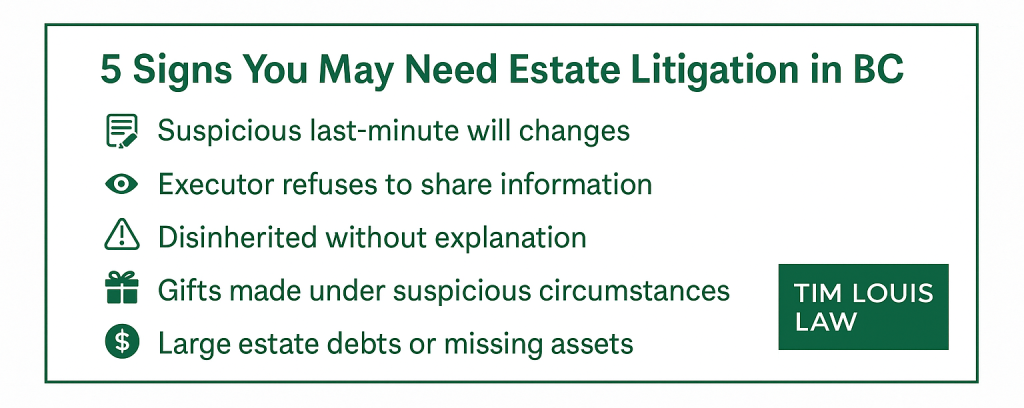
5 Signs you may need estate litigation in BC

This checklist is for informational purposes only and does not constitute legal advice. Please consult a lawyer for personalized guidance.

Why Litigation Can Help Preserve, Not Destroy, Family Honour

There’s a myth that estate litigation tears families apart.

But in truth, it’s often what prevents families from breaking down completely — from allowing resentment, confusion, and injustice to silently rot what was once strong.

Litigation isn’t about airing dirty laundry or picking fights. It’s about saying, “This doesn’t feel right,” and giving that feeling a safe, legal space to be heard. Because when questions about fairness or intent go unspoken, they don’t disappear — they fester. For years. Sometimes generations.

At Tim Louis Law, we’ve seen families lose each other not because they litigated — but because they didn’t. Because they let one person’s silence become the family story. Because they were too afraid to ask the questions that mattered most.

Litigation, when done right, is not about winning. It’s about revealing. And sometimes, the act of standing up for what’s right is what brings peace — not just to you, but to the memory of the one you’ve lost.

If you feel the weight of that silence pressing in… maybe it’s time to speak.

📞 Need Advice on Your Estate Dispute?

Tim Louis has helped countless families resolve estate conflicts with compassion and clarity.
Get a free, no-pressure consultation today.
👉 Request My Consultation

Real Client Success Story

After her parent passed away, a Vancouver woman found herself facing more than grief — she was facing uncertainty. A will had surfaced that didn’t reflect what she believed her parent truly intended. Family communication had broken down, and tension was mounting.

She didn’t want a fight. She wanted fairness. So, she reached out to a lawyer known not just for his experience — but for his kindness.

From the very first call, Tim Louis listened without judgment. He reviewed the situation, explained her rights under the Wills, Estates and Succession Act, and outlined clear, practical steps she could take.

With his guidance, she was able to move forward confidently. She found answers. She found closure. And she found her voice — at a time when she felt unheard.

“I highly recommend Tim Louis and Company,” she later wrote in a public review. “He helped me in a number of situations — primarily will and estate matters.”

Her story reminds us: estate disputes aren’t about blame. They’re about ensuring a loved one’s legacy is protected — with compassion, integrity, and care.

Why Tim Louis Focuses on Litigation — Not Mediation

At Tim Louis Law, we’ve chosen a clear path — and that path is litigation.

While many firms offer mediation as a softer alternative, we believe that in cases involving unfair wills, undue influence, or executor misconduct, litigation is often not only appropriate — it’s necessary.

Why?

Because mediation depends on everyone coming to the table in good faith. But in estate disputes, that’s not always the case. Power dynamics can be skewed. Documents can be hidden. And the person you’re up against might not have any interest in compromise.

Litigation, by contrast, puts everything on the record. It brings facts to light. It ensures that you’re not negotiating from a place of weakness — but with legal rights, a structured process, and experienced advocacy behind you.

We’re not here to start fights. We’re here to resolve them — fairly, firmly, and with dignity.

And if court is what it takes to protect your parent’s wishes or your rightful place in the estate… we’ll be there every step of the way.

What Makes Tim Louis Different in Estate Disputes

In a legal world that can feel cold, complex, and impersonal — Tim Louis is none of those things.

What sets Tim apart isn’t just his 40+ years of experience, though that matters. It’s his approach. His belief that law should feel human. That you deserve to be heard. And that every estate case, no matter how tangled or emotional, deserves time, care, and strategic clarity.

When you work with Tim, you won’t be passed from associate to associate. You’ll get direct access. Prompt responses. A lawyer who not only knows the law but knows how to listen.

He’s been helping clients like you navigate will challenges, executor disputes, and unfair estate outcomes across British Columbia for decades — and he’s built a reputation on trust, results, and compassion.

Most of all, Tim understands that this isn’t just a case. It’s your family. Your legacy. Your peace of mind.

And he’ll fight for all three — with skill and kindness.

About Estate Litigation in BC

What is estate litigation?

Estate litigation involves legal disputes about wills, trusts, executors, or the distribution of a deceased person’s assets. In BC, common estate cases include challenging a will, seeking a larger share of the estate, or addressing concerns of undue influence.

Can I challenge a will in British Columbia?

Yes. Under the Wills, Estates and Succession Act (WESA), spouses and children can challenge a will if they believe it is unfair or invalid due to undue influence, lack of capacity, or improper execution.

How long do I have to dispute a will in BC?

In most cases, you must file a wills variation claim within 180 days of the grant of probate. It’s critical to act quickly — once that window closes, you may lose your right to contest.

What are the chances of winning an estate dispute?

Every case is different, but with strong legal grounds and experienced representation, many BC residents successfully resolve estate disputes. Tim Louis helps clients understand their chances — clearly and honestly — before filing.

Will this end up in court?

Not always. Many estate disputes settle through negotiation or mediation. But when the other side won’t cooperate or fairness is at stake, going to court may be necessary — and we’re fully prepared.

Can I stop an executor from distributing the estate?

Yes. If you have a valid concern and act quickly, a court can issue an injunction to pause the distribution while the dispute is resolved.

Does challenging a will mean I’m suing my family?

It can feel that way, but estate litigation is about seeking fairness, not creating conflict. In many cases, it actually prevents long-term family breakdown by addressing issues before they deepen.

What kind of lawyer handles estate disputes?

You need an experienced estate litigation lawyer — someone who knows both the law and the courtroom. Tim Louis has helped clients in estate cases across BC for over four decades.

How do I get started?

Start with a free consultation. Tim Louis will listen to your story, explain your legal options, and help you decide if moving forward makes sense. 📞 Book your consultation: https://timlouislaw.com/contact

Key Takeaways

  • You’re not alone. Estate disputes are more common than most people think — and you have legal rights worth protecting.
  • Litigation isn’t the enemy of family. In fact, it can be the tool that restores fairness, protects legacies, and allows healing to begin.
  • Tim Louis is different. With over 40 years of experience in British Columbia law, Tim approaches each case with kindness, strategy, and commitment.
  • The clock is ticking. In BC, timelines for contesting a will are short — typically 180 days from probate. Acting quickly is key.
  • Clarity is one call away. Whether you’re unsure, anxious, or just need honest advice, Tim is here to help — with no pressure and no legal jargon.

“You don’t have to carry this alone. Let’s talk — and find a path forward that protects what matters most.”

📞 Free Consultation


Further Reading & Resources

Explore these trusted resources from Tim Louis Law to help you make informed legal decisions and protect what matters most.


More on Wills & Estates in BC


Understanding Estate Litigation

Downloadable Resource


Explore the FAQ Hub

  • Your Questions Answered: Estate Law in Plain English
    Visit our FAQ Hub for real answers to common legal questions — written for real people.
    https://timlouislaw.com/faq-hub

🔁 This page is part of our Living Content System and reviewed regularly for accuracy and legal compliance.

🕒 Last reviewed: by Tim Louis, Long Term Disability Lawyer in Vancouver

fired while sick
Employment
Tim Louis

Fired While Sick

Employment Law · Long-Term Disability Should You Sign a Severance Release If You Were Fired While Sick, on Medical Leave, or on LTD in BC? By Vancouver employment and LTD lawyer Tim Louis Quick answer Do not sign right away. If you were fired while sick, on medical leave, or

Read More »
Work, Volunteer, or Travel While on LTD in BC
Disability Claim
Tim Louis

Work Volunteer or Travel While on LTD in BC

Long-Term Disability Can You Work, Volunteer, or Travel While on LTD in BC? What Claimants Need to Know Before an Insurer Uses It Against Them By Long-Term Disability Lawyer Tim Louis If you are on long-term disability and trying to hold onto some version of ordinary life, this question can

Read More »

Do You Need an Estate Lawyer in Vancouver?

Do You Need an Estate Lawyer in Vancouver? Here’s How to Know

Do You Need an Estate Lawyer in Vancouver? Here’s How to Know

Wondering if it’s time to speak with an estate lawyer in Vancouver? Whether you’re creating a Will, administering a loved one’s estate, or facing a dispute over inheritance, the right legal advice can protect your family, honour your wishes, and prevent costly mistakes. In this guide, we’ll walk you through when to seek help, how BC law applies, and what to expect from working with a compassionate, experienced estate lawyer like Tim Louis.


By Tim Louis

Why Estate Law Matters in British Columbia

Estate planning may not be top of mind when life is busy, but in British Columbia, the stakes are too high to ignore. Whether you’re writing a Will, managing a loved one’s estate, or navigating a dispute, the decisions you make today can impact your family for generations.

BC’s unique legal framework — including the Wills, Estates and Succession Act (WESA) — gives the courts broad power to vary a Will. That means even carefully written estate plans can be challenged, delayed, or overturned without proper legal guidance. For families, this can result in costly court battles, emotional rifts, and years of uncertainty.

An experienced estate lawyer helps you make sense of the law, protect your wishes, and guide your family with clarity when it matters most. It’s not just about documents — it’s about peace of mind.

What an Estate Lawyer Actually Does in BC

Many people assume that an estate lawyer simply helps draft Wills. In reality, their role goes far deeper—especially in a province like British Columbia where estate laws are complex and highly regulated under WESA.

Here’s what an estate lawyer can help you with in BC:

Drafting and Updating a Will – A legally sound Will ensures your assets are distributed according to your wishes and reduces the risk of family disputes.

Creating Power of Attorney and Representation Agreements – These important documents protect you if you become incapacitated and need someone to make decisions on your behalf.

Establishing Trusts – Trusts can be used to protect beneficiaries, reduce taxes, and manage complex or blended family situations.

Advising Executors and Beneficiaries – If you’re named as an executor, a lawyer helps you meet legal responsibilities like applying for probate, notifying beneficiaries, and distributing assets properly.

Handling Estate Disputes – Estate lawyers also represent individuals in litigation, including will variation claims, undue influence allegations, or challenges to capacity.

Estate law isn’t one-size-fits-all. In BC, it takes insight and experience to ensure your legacy is protected and your loved ones are taken care of.


5 Signs You Should Hire an Estate Lawyer in Vancouver

Not sure if you really need a lawyer? You’re not alone. But in many cases, legal guidance can save your family from future stress, unexpected costs, or even litigation.

Here are five signs it’s time to talk to an estate lawyer:

  1. You Have a Blended Family
    If you have children from a previous relationship or stepchildren you wish to include, BC’s estate laws may not honour your intentions without a proper estate plan.
  2. You Own Property or a Business
    Real estate, rental properties, or small businesses add layers of complexity that require careful legal planning to avoid tax issues or probate delays.
  3. You Want to Prevent Disputes
    Wills can be challenged in BC—especially by spouses or children who feel left out. A lawyer helps draft your documents in a way that reduces the risk of future legal battles.
  4. You’ve Been Named as Executor
    Executors carry legal liability. If you’ve been asked to manage an estate, a lawyer can help ensure every step is handled properly and in compliance with the law.
  5. You’re Caring for Someone with a Disability or Vulnerability
    Special trusts, representation agreements, and advanced planning can protect vulnerable beneficiaries without jeopardizing benefits or supports.

When the stakes are high, legal advice isn’t just helpful—it’s essential. A short consultation today could save your family from years of uncertainty.


Estate Planning vs. Estate Litigation — How Legal Guidance Helps

In British Columbia, estate planning and estate litigation might sound like opposite ends of the legal spectrum — one proactive, one reactive. But they’re deeply connected, and both benefit from sound legal advice.

Estate Planning is the process of preparing for the future. It involves drafting documents like wills, trusts, and powers of attorney to ensure your wishes are clearly documented and legally enforceable. When done properly, it can:

  • Protect loved ones from confusion or conflict
  • Minimise taxes and probate costs
  • Account for unique family dynamics, including blended families or dependents with special needs
  • Reduce the chance of someone challenging your will under BC’s Wills, Estates and Succession Act (WESA)

Estate Litigation happens when something goes wrong. A Will is challenged. An executor is accused of misconduct. A beneficiary believes they’ve been treated unfairly. These disputes are emotionally and financially draining — and all too common in BC’s flexible estate law environment.

By working with an experienced estate lawyer early, you dramatically reduce the risk of litigation later. And if a conflict does arise, having trusted legal guidance ensures your rights are protected and the process moves forward efficiently.


Real Results – What Clients Say About Tim Louis

Estate planning isn’t just about documents — it’s about peace of mind. And when families across Vancouver need trusted legal guidance for wills, probate, or planning for the future, they turn to Tim Louis.

Here’s what some of his clients have said:

“Tim and his assistants prepared my will with efficiency and empathy. I was very pleased with the service.”
Dennis H.

“I highly recommend Tim Louis and Company. Tim helped me in a number of different situations — primarily wills and estate. Thoughtful, kind, and clear with his advice.”
Sue S.

 “I asked Tim to do my will. Great service — thanks so much Tim. Highly recommend.”
Jean S.

 “My husband and I had our wills updated by Tim and his very capable staff. We were very pleased with the quality of the service.”
Daphne D.

 “Tim helped us protect the financial future of our daughter with special needs. He is very ethical and has a brilliant mind.”
Phyllis S.

With four decades of experience and a reputation for compassionate, client-first service, Tim Louis makes estate planning feel less daunting — and more empowering.


Take Action Today – Request a Free Consultation

Planning your estate is one of the most important steps you can take to protect your family’s future — and you don’t have to navigate it alone.

Whether you’re preparing your first Will, updating an estate plan, or managing a loved one’s estate through probate, Tim Louis is here to help. With over 40 years of experience serving individuals and families across Vancouver and British Columbia, you can trust his guidance to be both compassionate and legally sound.

📞 Call (604) 732-7678 today for a free consultation.
✉️ Or email timlouis@timlouislaw.com to take the first step toward peace of mind.

Your legacy matters. Let’s make sure it’s protected.


Frequently Asked Questions – Do You Really Need an Estate Lawyer in BC?

  1. When should I hire an estate lawyer in British Columbia?

You should consider hiring an estate lawyer if:

  • You have a blended family or complex family structure
  • You own multiple properties or businesses
  • You’re concerned about will disputes or wills variation claims
  • You want to ensure your wishes are followed and avoid costly court battles
  1. Can I write my own will in BC without a lawyer?

Yes, British Columbia allows handwritten or online wills under the Wills, Estates and Succession Act (WESA). However, without legal advice, there’s a high risk the will could be invalid or contested, especially in complex situations.

  1. What does an estate lawyer actually do?

An estate lawyer:

  • Drafts wills, trusts, and powers of attorney
  • Helps with tax planning, blended family protection, and inheritance strategies
  • Advises on executor duties and probate
  • Prevents or resolves estate disputes with legally sound guidance
  1. How much does it cost to hire an estate lawyer in Vancouver?

Costs vary based on complexity. For a simple will, fees may start around $500–$800. Complex estate planning or litigation can cost more, but the long-term savings in avoided taxes, probate delays, and legal disputes often outweigh the fees.

  1. What’s the risk of using a DIY will kit in BC?

DIY will kits often fail to meet legal standards, leading to:

  • Invalid wills
  • Outdated clauses
  • Disinherited children or spouses
  • Legal challenges An experienced lawyer ensures your will complies with WESA and accurately reflects your intentions.
  1. Can an estate lawyer help prevent family conflict?

Yes. A well-drafted estate plan can:

  • Reduce the chance of contested wills
  • Clarify intentions around inheritance, property division, and beneficiaries
  • Prevent confusion or resentment after your passing This proactive step can help preserve family unity.
  1. Is estate planning only for wealthy people?

Not at all. Estate planning is for anyone who wants control over their legacy — including guardianship for children, funeral wishes, and asset distribution. Even modest estates benefit from legal protection and clarity.

  1. How do I choose the right estate lawyer in Vancouver?

Look for someone with:

  • Decades of experience in BC estate law
  • A track record in wills, probate, and estate disputes
  • A client-focused approach with clear, compassionate communication
    Tim Louis, for example, has over 40 years of experience and is known for his trusted, approachable style.
call to action

Key Takeaways: When to Call an Estate Lawyer in Vancouver

Wills aren’t just for the wealthy – Everyone can benefit from a legally valid will to avoid family stress and ensure their wishes are respected.
Estate planning prevents legal challenges – Early planning helps avoid disputes, protect vulnerable dependents, and honour blended family dynamics.
Probate can be complex – If you’re an executor or family member managing a loved one’s estate, legal guidance ensures you meet all legal duties in BC.
Wills variation claims are real – BC’s WESA law allows for legal challenges; having a lawyer reduces risks and helps craft a defensible plan.
Tim Louis makes it simple – With over 40 years of trusted service in Vancouver, Tim Louis is known for clear guidance, compassionate service, and legally sound solutions.

Further Reading: Learn More About Estate Planning in British Columbia

If you’re wondering whether it’s time to speak to an estate lawyer, the following resources provide deeper insight into British Columbia’s legal framework, your rights, and the services available to help you secure your legacy and protect your family’s future.

Understanding Wills Variation in British Columbia
Explore your rights under BC’s Wills, Estates and Succession Act (WESA) and how to contest or defend a will.
https://timlouislaw.com/wills-variation-lawyer/

Estate Lawyer Vancouver – Full-Service Support
Learn how Tim Louis helps clients across Vancouver draft wills, plan estates, and resolve disputes with compassion and expertise.
https://timlouislaw.com/estate-lawyer-vancouver/

Probate Lawyer Vancouver – Simplify the Legal Process
Need help navigating probate? This guide explains how a lawyer can help you with grant of probate, estate distribution, and executor duties.
https://timlouislaw.com/probate-lawyer-vancouver/

Wills Lawyer Vancouver – Plan for the Future with Confidence
Wills are more than documents—they’re a legacy. This page shows how Tim Louis ensures your will is valid, complete, and respected.
https://timlouislaw.com/wills-lawyer-vancouver/

Estate Litigation and Undue Influence
Concerned about undue influence or will fraud? This article explains your options when contesting a will or defending one.
https://timlouislaw.com/estate-litigation-and-undue-influence/

Wills, Estates and Succession Act (WESA) – Province of BC
The full legislation that governs wills, estates, intestacy, and succession in British Columbia.
https://www.bclaws.gov.bc.ca/civix/document/id/complete/statreg/09013_01

Public Guardian and Trustee of British Columbia
Offers guidance on incapacity planning, adult guardianship, and protecting vulnerable individuals during estate matters.
https://www.trustee.bc.ca/

BC Ministry of Attorney General – Estate Administration
Understand your responsibilities as an executor or administrator in BC.
https://www2.gov.bc.ca/gov/content/life-events/death/wills-estates/estate-administration

People’s Law School – Estate Planning Resources
An independent non-profit offering plain-language legal education on estate planning, wills, and power of attorney in BC.
https://www.peopleslawschool.ca/topics/wills-estates/

fired while sick
Employment
Tim Louis

Fired While Sick

Employment Law · Long-Term Disability Should You Sign a Severance Release If You Were Fired While Sick, on Medical Leave, or on LTD in BC? By Vancouver employment and LTD lawyer Tim Louis Quick answer Do not sign right away. If you were fired while sick, on medical leave, or

Read More »
Work, Volunteer, or Travel While on LTD in BC
Disability Claim
Tim Louis

Work Volunteer or Travel While on LTD in BC

Long-Term Disability Can You Work, Volunteer, or Travel While on LTD in BC? What Claimants Need to Know Before an Insurer Uses It Against Them By Long-Term Disability Lawyer Tim Louis If you are on long-term disability and trying to hold onto some version of ordinary life, this question can

Read More »
Scroll to top