(604)732-7678
2526 W 5th Ave, Vancouver, BC V6K 1T1

undue influence

Undue Influence in Estate Disputes

Undue Influence in Estate Disputes: What It Looks Like and How to Prove It

by Tim Louis

Estate disputes are never easy. They often come at a time of grief, confusion, and fractured family dynamics. Emotions run high — especially when someone believes that a loved one’s Will doesn’t reflect their true intentions.

One of the most troubling causes behind these disputes is undue influence: when someone manipulates a vulnerable person into changing their Will or estate plan. In British Columbia, this issue is becoming more common as our population ages and more seniors find themselves isolated or dependent on others for care.

At Tim Louis & Company, we understand how painful and overwhelming this situation can be. With over 40 years of experience protecting clients and challenging suspicious Wills, our team is here to provide compassionate, strategic legal support when you need it most. If you suspect that undue influence may have played a role in a recent estate change, you’re not alone — and you may have legal options.

undue influence in estate litigation

⭐⭐⭐⭐⭐

“Tim Louis is an outstanding human who happens to be a disability lawyer (among many other pursuits). He supported me through a very stressful time. I felt safe, heard, and protected.”
Mia, Verified Google Reviewer

We hear this question all the time

Q: How can you prove undue influence in a BC estate dispute?
A: To prove undue influence in BC, you need to show that the Will-maker was pressured to the point that the Will does not reflect their true intentions. Evidence may include sudden changes in the Will, isolation from family, or the involvement of a controlling caregiver. A lawyer can help gather medical records, witness accounts, and legal evidence.


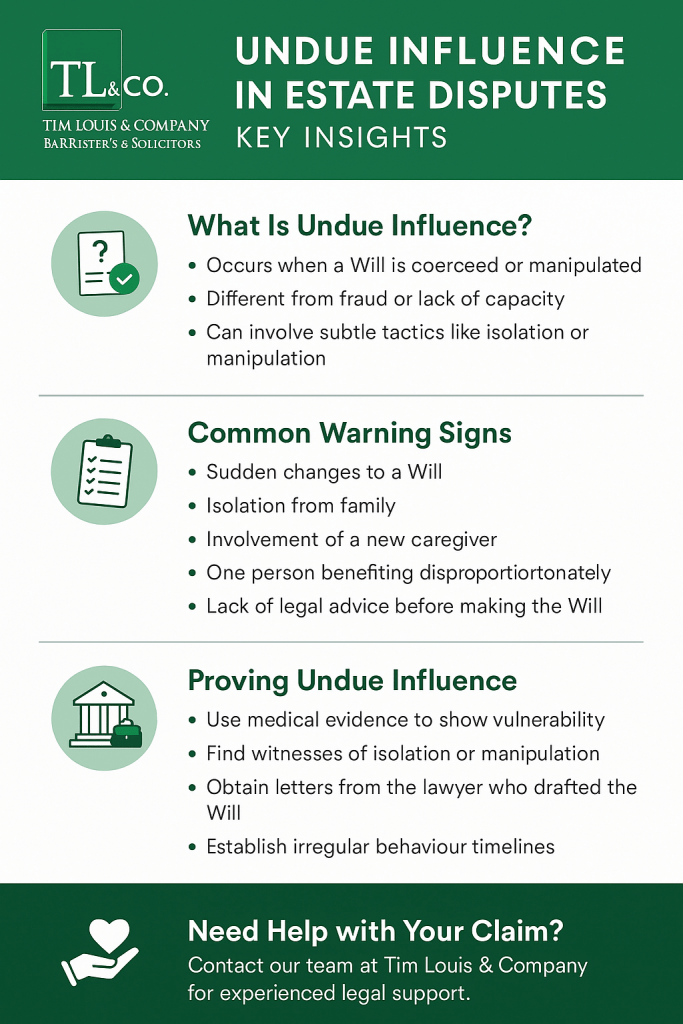
What Is Undue Influence?

When it comes to estate disputes in British Columbia, undue influence is one of the most emotionally complex — and legally challenging — issues to face. It occurs when a person exerts pressure on a vulnerable individual to change or create a Will in a way that benefits them unfairly. This pressure can be overt or subtle — and in many cases, it’s not easy to spot until it’s too late.

Legally, undue influence means that the person making the Will (the “testator”) was not acting freely and voluntarily. Instead, their free will was overpowered by someone they trusted — often a caregiver, adult child, or close family member.

It’s important to distinguish undue influence from:

  • Fraud – where someone deliberately deceives the Will-maker;
  • Mistake – where the Will was based on incorrect assumptions; or
  • Lack of capacity – where the Will-maker did not fully understand what they were doing.

Undue influence doesn’t always involve threats or obvious manipulation. It can happen quietly, over time. Some common red flags include:

  • The testator becoming increasingly isolated from other loved ones;
  • A sudden change in beneficiaries with no clear explanation;
  • A dependent relationship where one person controls access to food, shelter, finances, or care.

At Tim Louis & Company, we believe in protecting the wishes of those who may no longer be able to protect themselves. We stand up for fairness — and we have the experience to recognize undue influence when it happens.

“Undue influence often hides in plain sight — behind trust, routine, and dependence. At Tim Louis Law, we believe in exposing injustice and protecting the integrity of every Will.”
Tim Louis, Lawyer & Advocate

Case Snapshot:
A Vancouver senior revised her Will six months before passing, cutting out her two children and naming her caregiver as sole beneficiary. There were no witnesses to conversations, but her isolation and growing reliance on the caregiver raised concerns. After legal review and witness affidavits, the court found undue influence and reinstated the prior Will — restoring fairness to her estate.

Takeaway: If something feels off — document it. Courts in BC take undue influence seriously, especially when supported by medical records, financial timelines, or sudden changes in estate planning.


Common Warning Signs of Undue Influence in a Will

Undue influence doesn’t always leave obvious fingerprints. But certain red flags often point to coercion — especially when vulnerable individuals are involved. Here are the signs to watch for:

Checklist: Undue Influence Red Flags

  • Sudden changes to a Will — especially late in life or after a serious illness
  • Isolation from family and friends — the person becomes harder to reach or communicate with
  •  Involvement of a new caregiver or outsider — who wasn’t part of the original estate plan
  • One individual benefiting disproportionately — while others are minimized or removed
  •  No legal advice sought — the Will is prepared privately or without professional input

Tip from Tim Louis:

“When someone’s circumstances change rapidly and you notice emotional or physical dependence on a single person, it’s time to ask careful questions.”


Legal Tests & Proof of Undue Influence in BC Courts

In British Columbia, undue influence is a serious legal claim — and the courts apply a clear test to determine whether a Will should be set aside.

The Legal Standard (Leung v. Chan, 2023 BCCA)

BC courts often rely on the precedent from Leung v. Chan, which affirmed that:

“Where a relationship of potential dominance exists, and there are suspicious circumstances, the burden may shift to the person benefiting to disprove undue influence.”

When the Burden Shifts

Typically, the person alleging undue influence must prove it. But if there’s:

  • A relationship of dependency or trust
  • Significant change in testamentary intent
  • Or sudden benefit to a new party
    — the burden of proof can shift to the beneficiary to justify the change.

Evidence That Can Help Prove Undue Influence:

  • Medical reports showing mental or physical vulnerability
  • Witness statements (family, friends, professionals)
  • Financial records showing sudden control over accounts or access
  • The absence of legal advice during the creation of the Will

“Our team knows how to uncover the patterns and paper trails that suggest coercion. You don’t have to do it alone.” – Tim Louis

Undue influence in estates disputes

How to Prove Undue Influence in an Estate Dispute

If you believe a loved one was pressured or manipulated into changing their Will, proving undue influence in court takes a strategic and evidence-based approach. Here’s how to start building your case:

1. Compile Medical Evidence

Gather medical records that indicate the person was:

  • Experiencing cognitive decline, dementia, or serious illness
  • Dependent on others for daily care
  • Emotionally or physically vulnerable during the period in question

2. Gather Witness Statements

Testimony from family, friends, neighbours, and care staff can provide crucial context:

  • Was the individual isolated from family?
  • Were there signs of manipulation, pressure, or control by a specific person?
  • Did the atmosphere around them change in their final years?

3. Request Lawyer Notes

If the Will was drafted with the help of a lawyer, request:

  • Meeting notes and memos
  • Correspondence with the testator
  • Any red flags or comments about the person’s mental state or external pressure

4. Build a Timeline

Construct a clear timeline that shows:

  • When the Will was changed
  • Any sudden shifts in relationships or care arrangements
  • Unusual financial activity or asset transfers around that time

Proving undue influence is about connecting patterns. At Tim Louis Law, we help families uncover the truth with care and legal precision.


Ready to Take the Next Step?

Suspect undue influence in a Will or estate matter? Don’t wait. Our legal team at Tim Louis & Company has over 40 years of experience guiding families through sensitive estate disputes with compassion and clarity.

Free Initial Consultation
📍 2526 West 5th Ave, Vancouver, BC
📞 Call: (604) 732-7678
✉️ Email: timlouis@timlouislaw.com

Let us help you protect your loved one’s wishes — and your peace of mind.


What Happens If a Will Is Found Invalid?

When a will is declared invalid due to undue influence, several outcomes may follow — all of which can dramatically impact the estate and family dynamics.

  1. Reversion to a Previous Will

If an earlier, valid Will exists, the court may reinstate it. This can restore intended distributions and beneficiaries.

  1. Intestacy Rules Apply

If there’s no previous Will or if it’s also invalid, BC’s intestacy laws will dictate how the estate is distributed. That means:

  • The estate goes to the closest living relatives
  • Unintended individuals may receive nothing
  • Legal disputes may increase

3. Court Supervision of Distribution

The courts may oversee how the assets are distributed and appoint an administrator if the executor is also found unfit.

4. Legal and Emotional Costs

Disputes over Will validity can be emotionally taxing and financially costly. Having legal guidance from the start minimizes risk and provides peace of mind.


At Tim Louis & Company, we help families navigate these complex outcomes with care, transparency, and fierce advocacy when it matters most.

Frequently Asked Questions: Undue Influence in BC Estate Disputes

  1. What is “undue influence” in a Will in British Columbia?

Undue influence occurs when someone pressures or manipulates a Will-maker to change their will in a way that doesn’t reflect their true intentions. It may involve subtle coercion, isolation, emotional abuse, or dependency. In BC, if proven, a will made under undue influence can be declared invalid.

2. What are signs of undue influence in a Will?

Common signs include:

  • Sudden or drastic changes to the will
  • One person receiving the majority of the estate
  • Isolation of the will-maker from family or advisors
  • Lack of legal advice or rushed will signing
  • New caregivers or acquaintances appearing late in life

3. Who has the burden of proof in BC undue influence cases?

Initially, the burden is on the person challenging the Will. However, if certain suspicious circumstances are shown, the burden can shift to the beneficiary to prove there was no undue influence. This is based on legal precedents like Leung v. Chan.

4. How do I prove undue influence in a BC court?

Key evidence includes:

  • Medical records showing cognitive decline or vulnerability
  • Witness testimony of manipulation or coercion
  • Notes from the lawyer who drafted the Will
  • Financial records showing sudden changes or control

5. Can a Will be overturned due to undue influence in BC?

Yes. BC courts can declare a Will wholly or partially invalid if undue influence is proven. This can lead to an earlier will being reinstated or default intestacy rules being applied.

6. What should I do if I suspect undue influence?

You should consult an experienced estate litigation lawyer immediately. Early legal advice can help preserve evidence, protect your rights, and prevent the wrongful distribution of assets.

Still have questions? Contact Tim Louis & Company for a free, confidential consultation. We’re here to help.

⭐⭐⭐⭐⭐
“Tim Louis is very compassionate, kind and supportive. Highly recommended.”
Teresa Calalang, Google Reviewer

Tim Louis & Company offers compassionate, experienced legal advice to protect your family’s legacy.

📞 Call: (604) 732-7678
📧 Email: timlouis@timlouislaw.com
🌐 Learn More: https://www.timlouislaw.com

Your consultation is free. Your peace of mind is priceless.

Further Reading: Estate Law & Undue Influence in BC

Understanding Will Disputes in BC

  1. Estate Litigation & Probate Services – Tim Louis Law
    Learn how Tim Louis Law assists clients navigating contested Wills, probate conflicts, and estate litigation with empathy and legal precision.
    https://timlouislaw.com/probate-lawyer-vancouver/
  2. Probate Pitfalls in BC: What You Need to Know
    Explores common issues families face during probate, especially when a Will is challenged or absent.
    https://timlouislaw.com/estate-planning-probate-wills-in-vancouver/


Legal Concepts Related to Undue Influence

  1. Wills and Estate Planning – Tim Louis Law
    An overview of Tim’s approach to crafting secure, conflict-free Wills with special attention to elder care and capacity concerns.
    https://timlouislaw.com/wills-lawyer-vancouver/
  2. What Happens If You Die Without a Will in BC?
    A legal guide outlining the consequences of dying intestate in British Columbia and who inherits what.
    https://willsandprobatelawyer.ca/what-happens-when-you-die-without-a-will-in-bc/


Preventing Future Disputes

  1. How to Write a Valid Will in Canada
    A clear guide for families, couples, and individuals on the legal steps needed to draft a defensible Will.
    🔗 https://willsandprobatelawyer.ca/write-a-will-in-canada/
  2. Legal Considerations for Blended Families
    Addresses how Wills can be drafted to fairly protect spouses, stepchildren, and biological children.
    https://timlouislaw.com/faq/


Related Legal Areas

  1. Long-Term Disability Claims Involving Mental Capacity
    Highlights how LTD claims can be affected by cognitive decline and how legal guidance protects clients’ rights.
    https://timlouislaw.com/long-term-disability-lawyer-vancouver/
  2. FAQ: Your Rights in a Family Estate Conflict
    A resource of answers to common estate litigation questions, particularly in cases involving undue influence.
    https://timlouislaw.com/faq/
🔁 This page is part of our Living Content System™ and is reviewed regularly for accuracy and legal compliance.
🕒 Last reviewed: by Tim Louis, Long Term Disability Lawyer in Vancouver
Winter Slip and Fall in Vancouver- What Evidence Helps
Personal injury
Tim Louis

Winter Slip and Fall in Vancouver

Vancouver winter slip and fall claims Winter Slip and Fall in Vancouver: What Evidence Helps and What Deadlines Matter by Personal Injury Lawyer Tim Louis If you slipped on ice, snow, or slush in Vancouver, the two things that matter most are evidence and deadlines. Where you fell can change

Read More »
Cognitive LTD Claims in BC
cancer
Tim Louis

Chemo Brain and Cognitive LTD Claims in BC

“Chemo Brain” and Cognitive LTD Claims in BC: What Evidence Helps By Long-Term Disability Lawyer Tim Louis If your thinking still feels slower or less reliable after cancer treatment, you are not alone, and you are not imagining it. The key is documenting clear, work-related restrictions with medical support, not

Read More »

Undue Influence in Estate Litigation

Unraveling Undue Influence in Estate Litigation: A Comprehensive Guide

Navigating the complexities of estate litigation can be a daunting task, especially when undue influence comes into play. This comprehensive guide aims to shed light on the intricacies of undue influence, its implications in estate litigation, and how it is addressed within British Columbia’s legal framework. If you suspect that you or a loved one has fallen victim to undue influence, this guide will provide you with the necessary knowledge to take the next steps.

Understanding Undue Influence

Undue influence is a term used to describe a situation where a person, often in a position of power or trust, manipulates another into making decisions that they would not ordinarily make. In the realm of estate planning, undue influence can significantly alter the decisions a person makes about their estate, leading to disputes and legal battles after their death. It can manifest in various forms, such as pressuring a person into making certain provisions in their will or transferring assets before their death. It can also occur when a person is manipulated into making decisions that favor one party over others, leading to an unfair distribution of assets.

"Undue influence consists of imposing pressure or some form of subterfuge that causes a person to perform a legally significant act, such as making a gift, a will, or granting a power of attorney, that does not reflect the genuine wishes or intentions of that person, but rather those of the influencer." – Undue Influence Recognition and Prevention: A Guide for Legal Practitioners
Undue Influence in Estate Litigation

The Legal Landscape in British Columbia

In British Columbia, the law relating to undue influence has undergone significant changes with the introduction of the Wills, Estates and Succession Act (WESA). Prior to WESA, contesting the validity of a will on the grounds of undue influence was a challenging task. The burden of proof was on the person challenging the will, and failure to prove fraud could result in the payment of special costs. However, under Section 52 of WESA, the onus of disproving undue influence has shifted to the person who has received the gift under the will. This shift in the burden of proof has significant implications for estate litigation, allowing for a greater number of cases alleging undue influence to be successful.

Identifying Undue Influence

Recognizing undue influence can be challenging, as it often occurs behind closed doors and can be subtle. However, there are certain signs that may indicate the presence of undue influence.

These include:

  • The caregiver of the will-maker is a beneficiary or is connected to a beneficiary.
  • Instructions that seem out of character in light of the will-maker’s family circumstances.
  • Physical or mental health issues that may lead to the will-maker being more susceptible to being taken advantage of.
  • Preparation or execution of the will is kept a secret, and the will-maker wants the process completed in haste without informing any family members.
  • Significant and poorly explained changes from a prior will.

estate litigation and undue influence

Seeking Legal Assistance

If you suspect that you or a loved one has been a victim of undue influence, it is crucial to seek legal assistance as soon as possible. At Tim Louis Law, we are committed to providing the guidance and support you need during this challenging time. Our team of seasoned lawyers has a wealth of experience in estate litigation and can help you navigate the complexities of undue influence claims. Don’t let undue influence rob you of your rights – take action today and ensure that justice is served. Give Tim Louis a call today at (604) 732-7678 for a no-fee telephone consultation, during which he will answer all your questions, no matter how complex.

Conclusion

Undue influence in estate litigation is a serious issue that can have far-reaching implications. By understanding the law and recognizing the signs of undue influence, you can take steps to protect yourself and your loved ones. If you suspect undue influence, don’t hesitate to reach out to a legal professional like Tim Louis for guidance and support. His expertise and dedication can help you navigate the complexities of estate litigation and ensure that justice is served.

About Tim Louis

Tim Louis is a highly respected lawyer based in Vancouver, British Columbia. With a career spanning several decades, he has built a reputation for his unwavering commitment to his clients and his comprehensive knowledge of estate litigation. Whether you’re dealing with a dispute over a will, a claim of undue influence, or any other estate-related issue, Tim Louis and his team are ready to provide the legal support you need.

Why Choose Tim Louis Law?

Choosing a lawyer to represent you in estate litigation is a significant decision. You need someone who not only understands the law but also appreciates the emotional complexities involved in these cases. Tim Louis offers a unique blend of legal expertise and compassionate service. He understands that estate disputes can be emotionally charged and strives to provide a supportive environment for his clients.

When you choose Tim Louis Law, you’re not just getting a lawyer – you’re getting a dedicated advocate who will fight for your rights and interests. Tim Louis and his team will work tirelessly to ensure that you receive the justice you deserve.

Contact Tim Louis Today

If you believe that you or a loved one has been a victim of undue influence, don’t wait – contact Tim Louis Law today. Visit Tim Louis Law to schedule a consultation and learn more about how Tim Louis can assist you in your estate litigation case. Don’t let undue influence rob you of your rights – take action today and ensure that justice is served.

FAQ

Undue influence refers to a situation where a person, often due to their position of power or trust, coerces or manipulates another into making decisions that they would not have made under normal circumstances. This manipulation can significantly alter the decisions a person makes about their estate, leading to disputes and legal battles after their death.
Lorem ipsum dolor sit amet, consectetur adipiscing elit. Ut elit tellus, luctus nec ullamcorper mattis, pulvinar dapibus leo.
Recognizing undue influence can be challenging, but there are certain signs that may indicate its presence. These include the caregiver of the willmaker being a beneficiary, instructions that seem out of character for the willmaker, the willmaker having physical or mental health issues, and the preparation or execution of the will being kept a secret.
Choosing a lawyer to represent you in estate litigation is a significant decision. Tim Louis offers a unique blend of legal expertise and compassionate service. He understands that estate disputes can be emotionally charged and strives to provide a supportive environment for his clients. When you choose Tim Louis Law, you’re not just getting a lawyer – you’re getting a dedicated advocate who will fight for your rights and interests.
Contact Tim Louis

Key Takeaways

  1. Undue influence is a form of financial abuse and a legal doctrine. It typically operates by exploiting dependencies, abusing relationships of trust and confidence, emotional manipulation, and isolating the victim.
  2. Persons of any age may become victims of undue influence. Susceptibility can be increased by illness, disability, impaired mental function, financial insecurity, and combinations of these.
  3. Undue influence can range anywhere from outright coercion to deceit, manipulation through fear, or wearing down a vulnerable victim by importuning or deliberate supply of misinformation over a period of time.
  4. The grant of a power of attorney creates a fiduciary relationship between the donor and the attorney, but this alone does not create a relationship from which the presumption of undue influence will invariably arise. The presumption does arise, however, if the power of attorney is used to benefit the attorney.

Further Reading:

Understanding Undue Influence in Estate Litigation
Gain a deeper understanding of undue influence in estate litigation with this comprehensive guide. It explores the concept of undue influence, its implications in estate litigation, and how it is addressed in British Columbia’s legal system. This resource is invaluable for anyone seeking to protect their rights and interests in estate matters. Read more

Estate Litigation and Undue Influence
This page provides a detailed overview of estate litigation and undue influence, offering valuable insights into how these issues are handled in the legal system. It’s a must-read for anyone dealing with these complex matters. Read more

Guide on Undue Influence: Recognition and Prevention
This guide from the British Columbia Law Institute provides an in-depth look at undue influence, including how it works and how it can be prevented. It’s a valuable resource for legal practitioners and anyone interested in understanding this complex issue. Read more

The Law Society of British Columbia: Guide on Undue Influence
This guide provides a comprehensive overview of undue influence in the context of the Canadian legal system. It’s a valuable resource for anyone seeking to understand the intricacies of this legal concept. Read more

"Susceptibility to Undue Influence: The Role of the Medical Expert in Estate Litigation"
This insightful article delves into the role of medical experts in estate litigation, particularly in cases involving undue influence. It explores how undue influence can subvert a testator’s free will, leading to significant changes in the distribution of an estate. The piece provides a comprehensive understanding of the susceptibility to undue influence and the crucial role medical experts play in such cases.
Read More

Scroll to top